
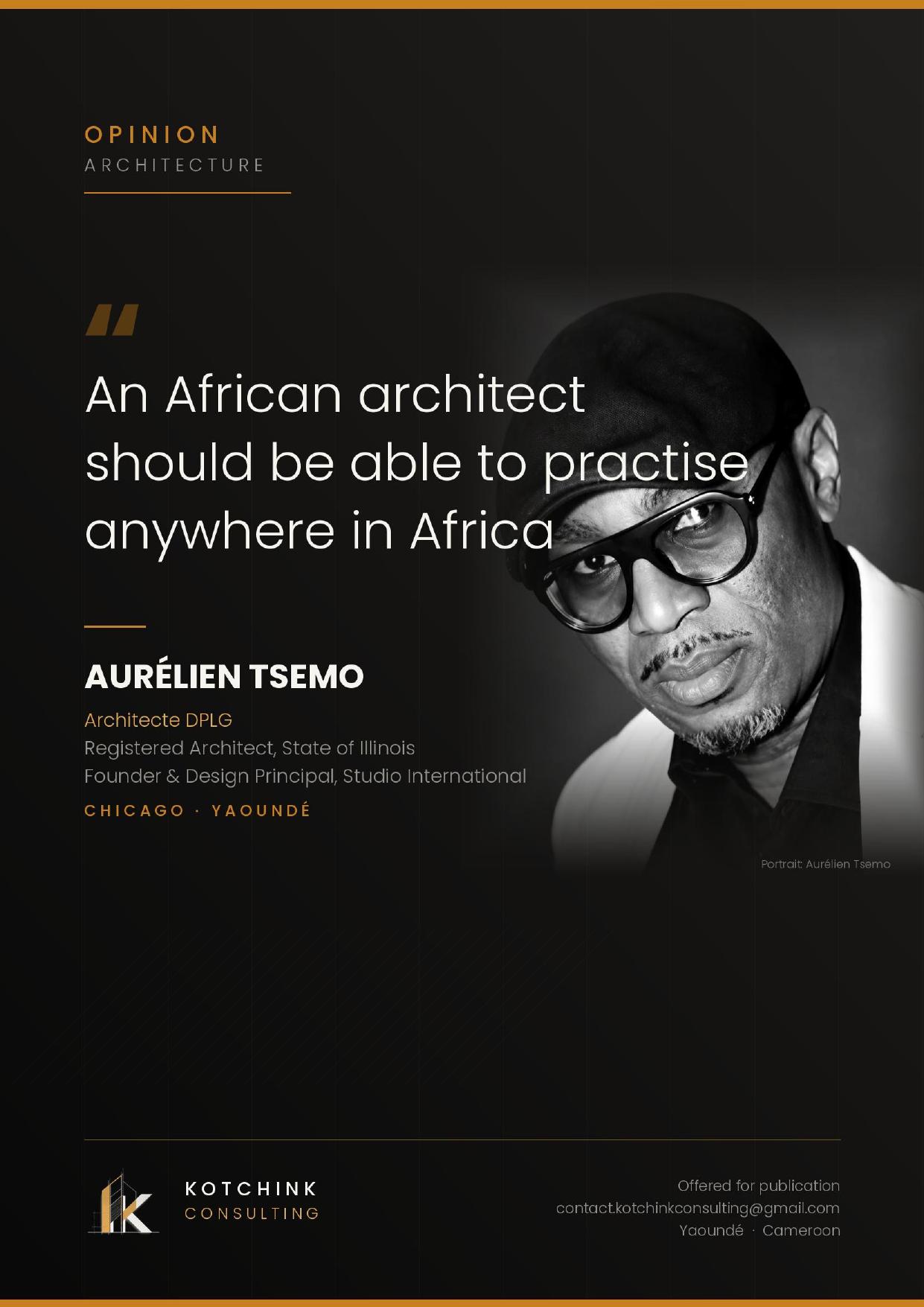
I am an architecte DPLG in France and a registered architect in the State of Illinois. In the United States, architecture is treated in the same way as medicine and law: as a profession that engages the personal liability of the practitioner. The degree is followed by some three years of supervised experience and then the licensing examination. Mine ran to nine divisions, several of which I had to sit twice. I do not regret it. That level of rigour protects the occupants of buildings, and it protects the profession.
I am building in Yaoundé today, and I am not yet entered on the register of Cameroon’s National Order of Architects. I have begun the necessary steps. This is hardly a country I am discovering: I worked there for many years alongside Théophile Yimgaing Moyo, now deceased, whose associate I was in Cameroon. And I say this all the more freely because my application is under way: when one practises a regulated profession, one must plainly be in good standing with the institutions that govern it. The Order does important work on behalf of the profession, and I intend to regularise my position shortly.
But consider now a Cameroonian colleague, duly registered, who is offered a project tomorrow in Dakar, in Abidjan or in Libreville. He cannot simply establish himself there and practise. Every board sets its own conditions of entry, its own timescales, its own requirements. Put plainly: an African architect today moves more easily from one continent to another than within his own continent.
We lament that our great projects go abroad. Yet we have built a continent on which the African architect cannot work next door.
This is where the paradox becomes hard to sustain. We lament, and I lament with you, that so many major African commissions continue to be awarded first to foreign practices. I read in this the sign of a deeper unease: perhaps we still find it difficult to believe that we are capable of building our own architectural future. But how can one reproach a client for looking elsewhere when our own rules prevent African competence from circulating within Africa?
That such competence exists, no one can seriously doubt. African architects have demonstrated their ability to work at the highest international level: I think of Francis Kéré and David Adjaye, and they are not the only ones. And I can testify, after thirty years spent in two of the most demanding practices in Chicago, that a practice’s foreign origin is no guarantee whatever of a better outcome. It guarantees only higher fees and, very often, a poorer grasp of the context.
Fragmentation costs us more than we measure. It deprives us of African practices of continental scale, able to compete on equal terms for major commissions. It prevents experience from accumulating: each country relearns alone what its neighbour has already learned. And it drives our ablest young professionals to seek beyond the continent a mobility they cannot find within it; I know something of this: I left at seventeen.
What I propose is simple, and could begin tomorrow. All architectural organisations on the continent must draw closer together: joint meetings, exchanges of practice, and in time an African congress of architects’ registration boards. No such congress exists. It ought to. It would be the natural forum in which to open the one question that truly matters: the mutual recognition of registration, first at sub-regional level, then across the continent.
The model exists, and has worked for a long time. In the United States, architecture is regulated state by state: seen in that light, each American state is the equivalent of an African country. Yet NCARB, the body that brings together the registration boards of the country’s fifty-five jurisdictions, issues a certificate attesting that an architect meets a common national standard. That certificate does not replace the licence: it opens the way to registration in other jurisdictions without having to resit the examinations or reconstitute the entire file. I am registered in Illinois; holding that certificate, I can obtain a licence in New York, Mississippi, or elsewhere upon application to the local board. Every jurisdiction accepts it, and twenty-five require it. Only California maintains a supplementary examination, from which no one is exempt, covering its own body of law: building codes, accessibility, and energy efficiency.
I am registered in Illinois; that certificate opens the way to licensure in the other fifty-four jurisdictions without requiring me to repeat the national examinations.
This, then, is no single window: each authority retains control over whom it admits. It is a lighter file, resting on a common standard. Nothing prevents Africa from building a comparable arrangement. The congress I speak of would be precisely the place to negotiate such equivalences. The difficulty is known, and I do not underestimate it: a common baseline is required. The level of training, academic and above all professional, must be comparable from one country to the next, so that an architect registered in Cameroon is recognised in Côte d’Ivoire, in Senegal or in Kenya without anyone needing to ask questions.
That in turn requires us to agree on what it is we do. Here is the definition I give of our profession, and I set it down in the language in which I thought it:
Architecture is the art and discipline of shaping space and the built environment to enrich human experience while responding to the cultural, social, environmental, and material realities of place.
That definition does not change between Yaoundé and Nairobi. The art and the discipline are the same; what changes are the cultural, social, environmental and material realities to which one must respond. That is precisely why equivalence is possible: what varies from one country to another is not competence but context, and a trained architect knows how to read a context.
Let me add this, which is my conviction as a practitioner: architecture should belong to its place. It is a response, not an assertion. It arises from listening to the land, the climate, the culture, the history and the people, and every project ought to be approached as a singular response to its context, drawing these forces together into a coherent whole. That is also why the movement of architects across the continent holds no fear for me: whoever has learned to listen to one place will know how to listen to another.
One could go further still and establish a dedicated body charged with organising this reciprocity between countries. A Cameroonian colleague wishing to compete or to work in Abidjan would apply to it, pay for the service, and it would handle the formalities and the documents required to establish his equivalence. It is simple, it is financially viable, and I am convinced it would work.
Mutual recognition is not deregulation. It is the opposite: it is placing trust in our own institutions.
I want to be precise on this point, for I would not wish to be misunderstood. Recognising the registration of a colleague from another African country does not mean abolishing scrutiny. Professional liability, insurance, ethics, knowledge of the local context, association with a colleague established on the ground: all of this must remain. What I am asking for is not less rigour, but shared rigour. Registration obtained in Yaoundé, in Dakar or in Nairobi should carry a presumption of competence elsewhere on the continent, subject to conditions, but without having to begin again from nothing.
I would add that movement alone is not enough: we must also pass on what we know. At my practice in Chicago, I established a professional immersion programme for young African architects: a placement of several months, with visa and travel costs covered, accommodation provided, and a stipend paid throughout. The first intended beneficiaries were Cameroonian. One of the candidates selected withdrew at the last moment, after the practice had already incurred substantial expense. I drew a lesson from it, which I offer without bitterness: one cannot mentor people who are not ready to be mentored. Transmission requires two wills, the one that gives and the one that receives. Our institutions can create the framework; it will fall to the young to seize it.
We speak a great deal of cooperation between Africa and the rest of the world. We speak little of cooperation between African countries. Yet that is where we ought to begin. If Africa is moving toward some form of Pan-Africanism, then at some point we shall have to accept that an African is at home anywhere on the continent. That holds for people, it holds for skills, and it holds for our profession.
This protectionism must be lifted. Let us begin with our own boards.